TRT Alternatives: A Decision Guide for Low Testosterone


You got your blood test back and your testosterone is low. Your first thought is probably TRT. But here's the thing: testosterone replacement therapy is a lifelong commitment that shuts down your body's own production. For some men it's the right call. For others, there are better options they never hear about.
This guide breaks down every real alternative to TRT, what actually works, what doesn't, and how to figure out which path fits your situation. No medical degree required.
This is not medical advice. It's an evidence-based overview to help you have a better conversation with your doctor. Always work with a qualified physician before starting any treatment.
First things first: do you actually need TRT?
Before you even think about treatment, you need to understand why your testosterone is low. A single blood test number doesn't tell the whole story.
Make sure the test was done right
Testosterone peaks in the morning and drops throughout the day. An afternoon blood draw can read 20-25% lower than a morning one. If your test was done after midday, that "low" result might be completely normal.
The rules are simple:
- Blood draw between 7-10am
- Fasting (no food that morning)
- Two separate low readings on different days before any diagnosis
Up to 30% of men with one low reading will come back normal on a repeat test (McBride et al., 2016). So don't panic over a single number.
The two types of low testosterone
This is where most guys get confused, but it's actually straightforward. Your body makes testosterone through a chain of command:
- Your brain (hypothalamus) sends a signal
- Your pituitary gland receives it and releases two hormones: LH and FSH
- Your testes get the message and produce testosterone
When testosterone is low, the problem is either at the testes or at the brain. Two simple blood markers tell you which:
Primary hypogonadism (the factory is broken): Your LH and FSH are HIGH but testosterone is still low. The brain is screaming at the testes to produce more, but they can't. This usually means TRT is your best option because the testes themselves aren't working properly.
Secondary hypogonadism (head office stopped sending orders): Your LH and FSH are LOW or normal, and testosterone is low too. The brain isn't sending a strong enough signal. This is actually good news because you have more options: medications like enclomiphene or HCG can fix the signal problem without replacing your testosterone.
Could something else be causing it?
Low testosterone is often a symptom, not the root problem. Before jumping to any treatment, rule these out:
- Obesity: 50-70% of men with metabolic syndrome have low testosterone (Kelly & Jones, 2015). Fat tissue converts testosterone to estrogen, which tells your brain to produce less. Losing weight can fix this entirely.
- Sleep apnea: Disrupted sleep tanks the overnight testosterone surge your body depends on.
- Thyroid problems: Low TSH or thyroid hormones mimic low-T symptoms almost perfectly.
- High prolactin: Elevated prolactin directly suppresses the brain signals that drive testosterone production.
- Chronic stress or poor sleep: Even one week of 5-hour nights reduces testosterone by 10-15% (Leproult & Van Cauter, 2011).
- Medications: Opioids and corticosteroids suppress testosterone and the effect reverses when you stop them.
If any of these apply to you, fix the root cause first and retest in 3-6 months. You might not need TRT at all.
The pros and cons of TRT
Let's be fair to TRT. It works, and it works well. But it comes with trade-offs you should understand before committing.
What TRT does well
When testosterone is genuinely low and TRT is the right call, the benefits follow a predictable timeline (Saad et al., 2011):
| What improves | When you'll notice |
|---|---|
| Sex drive (libido) | 3 weeks, peaks at 6 weeks |
| Mood and motivation | 3-6 weeks, peaks at 3-6 months |
| Energy and quality of life | 3-4 weeks |
| Body composition (less fat, more muscle) | 3-4 months, stabilises at 6-12 months |
| Erections | Up to 6 months |
| Bone density | 6+ months |
The 2023 TRAVERSE trial, the largest cardiovascular safety study on TRT ever done (5,246 men), found no increase in heart attacks or strokes compared to placebo (Lincoff et al., 2023). That's reassuring for men who were worried about heart risk.
The downsides you need to know
It's a lifelong commitment. TRT shuts down your brain's signal to the testes. Your body stops making its own testosterone within weeks. If you want to come off later, recovery takes a long time: roughly 14 months for sperm production and up to 38 months for sperm motility to return (Christin-Maitre & Young, 2022). Some men, especially older ones, never fully recover.
Fertility takes a hit. About one in three men on TRT will have zero sperm count within 6 months. If you want kids now or in the near future, TRT on its own is a bad idea. This is one of the biggest reasons men look for alternatives.
You need regular blood tests. TRT raises haematocrit (the thickness of your blood). Studies show 10-30% of men on TRT develop polycythaemia over 1-2 years (Rotker et al., 2018), and men who develop it face a 35% higher risk of major cardiovascular events or blood clots in the first year (Ory et al., 2022). You also need to monitor estradiol, which can climb too high and cause its own problems. Check out our estradiol management guide for the full breakdown.
Injections or daily gel. Most TRT is delivered via weekly injections (testosterone enanthate or cypionate) or daily topical gel. Neither is a dealbreaker, but it's worth knowing this is something you'll do every week, potentially forever.
If you're in Australia and have decided TRT is right for you, read our complete guide to starting TRT in Australia for clinic options and what to expect.
Alternative 1: lifestyle changes
This sounds boring compared to a prescription, but the data is surprisingly strong for certain situations.
Weight loss
If you're carrying extra body fat, this is the single most impactful thing you can do. A meta-analysis of 24 studies found that a low-calorie diet alone raised testosterone by about 2.87 nmol/L (83 ng/dL), and bariatric surgery raised it by 8.73 nmol/L (252 ng/dL) (Corona et al., 2013). That's a meaningful jump, especially for men in the borderline-low range.
The mechanism is straightforward: fat tissue contains aromatase, an enzyme that converts testosterone into estrogen. Less fat means less conversion, which means more testosterone stays in your system and your brain gets a cleaner signal to keep producing it.
Sleep
This one is non-negotiable. Sleeping only 5 hours a night for one week drops testosterone by 10-15% in healthy young men (Leproult & Van Cauter, 2011). Your body produces most of its testosterone during deep sleep, so if sleep quality is poor (whether from late nights, sleep apnea, or scrolling your phone until 2am), fix that before anything else.
Resistance training (especially heavy compound lifts)
A 12-week study in overweight men showed resting testosterone increased by about 19% (Moradi, 2015). The effect is real but modest, and it's strongest in men who are currently sedentary or overweight. If you're already training hard, adding more sets won't meaningfully move the needle on baseline testosterone.
Not all exercises are equal here. Heavy compound movements that recruit large muscle groups produce the biggest acute testosterone spikes:
- Squats and deadlifts are the gold standard. They hit your quads, glutes, hamstrings, and back all at once, triggering the largest hormonal response.
- Bench press, rows, and overhead press are solid runners-up.
- Isolation exercises (bicep curls, lateral raises) barely move the needle hormonally. They're fine for building muscle, but they won't help your testosterone.
The sweet spot for hormonal response is heavy weight (70-85% of your one-rep max), moderate volume (3-5 sets of 5-8 reps), and short rest periods (60-90 seconds). Marathon-length cardio sessions actually do the opposite: prolonged endurance exercise can temporarily suppress testosterone through elevated cortisol.
Foods that support testosterone
No single food will fix low testosterone, but your overall diet matters more than most men realise. A few things to focus on:
Eat enough fat. Testosterone is literally made from cholesterol. Very low-fat diets (below 20% of total calories from fat) are associated with lower testosterone levels. You don't need to drown everything in butter, but don't fear dietary fat either. Good sources: eggs (whole, not just whites), olive oil, avocado, nuts, and fatty fish like salmon.
Eat enough calories. Crash dieting tanks testosterone hard. If you need to lose weight, aim for a moderate deficit (500 calories below maintenance), not a starvation diet. Your body interprets severe calorie restriction as a survival threat and downregulates reproductive hormones accordingly.
Specific foods with evidence: Eggs are one of the best natural sources of cholesterol, vitamin D, and zinc in one package. Oysters and red meat are high in zinc. Cruciferous vegetables (broccoli, cauliflower, cabbage) contain compounds called indoles that help your body metabolise estrogen more efficiently, which indirectly supports testosterone. Pomegranate juice has shown modest benefits in small studies, but nothing dramatic.
What to limit: Excessive alcohol is a testosterone killer. Heavy drinking suppresses the HPG axis directly and increases aromatase activity (more testosterone converted to estrogen). Highly processed foods and excessive sugar contribute to insulin resistance and weight gain, both of which lower testosterone. Soy in moderate amounts is fine despite the internet panic, but consuming massive quantities of soy protein isolate daily is probably not ideal.
Realistic expectations
Here's the honest truth: lifestyle changes alone rarely move a man from clinically low testosterone (below 8 nmol/L / 230 ng/dL) to the optimal range. They work best for men in the borderline zone (8-14 nmol/L) where a few nmol/L makes the difference between feeling terrible and feeling fine. Give it 3-6 months of consistent effort, then retest.
Alternative 2: supplements (what actually works)
The supplement industry loves selling "testosterone boosters." Most of them are rubbish. A 2019 analysis of the top testosterone-boosting products on Amazon found that only 30% of their ingredients had any evidence of raising testosterone, and after filtering out fake reviews, libido claims dropped by 91% (Balasubramanian et al., 2019).
That said, a few supplements do have legitimate evidence, with an important catch.
Actually works (if you're deficient)
Vitamin D: A year-long trial in men with low vitamin D showed supplementation raised testosterone from 10.7 to 13.4 nmol/L, a gain of about 2.7 nmol/L (Pilz et al., 2011). But a follow-up study in men with normal vitamin D levels found zero testosterone effect (Lerchbaum et al., 2017). The takeaway: get your vitamin D tested first. If you're deficient, supplement. If you're not, it won't help your testosterone.
Zinc: Zinc-deficient elderly men who supplemented for 6 months nearly doubled their testosterone, from 8.3 to 16.0 nmol/L (Prasad et al., 1996). Same rule: this only works if you're actually deficient. Piling on zinc when your levels are fine won't do anything except upset your stomach.
Ashwagandha (KSM-66): This is the strongest supplement that works regardless of deficiency status. An 8-week trial in young men showed a testosterone advantage of about 78 ng/dL over placebo (Wankhede et al., 2015), and a 16-week crossover study confirmed a 14.7% greater testosterone increase (Lopresti et al., 2019). It appears to work by lowering cortisol, which removes a brake on testosterone production.
Limited evidence
Fenugreek (Testofen): Some positive results in industry-funded trials, but the evidence base is thin and commercially driven (Rao et al., 2016). Might help, probably won't hurt, wouldn't rely on it alone.
Boron: Biologically plausible (it may lower SHBG, freeing up more testosterone), but no solid clinical trials to back the claims.
Save your money
Tribulus terrestris: Reviews consistently find no evidence it raises testosterone in humans (Pokrywka et al., 2014).
Proprietary "test booster" blends: The Amazon analysis says it all. Most are expensive placebos with good marketing. They typically combine low doses of ingredients that individually have weak or no evidence, slap a jacked guy on the label, and charge $50-80 a bottle. If a supplement needs to hide its ingredient doses behind a "proprietary blend," that's a red flag. The ones that do list doses usually contain amounts far below what the actual studies used.
If you want to try supplements, buy the individual ingredients separately (vitamin D, zinc, magnesium, ashwagandha KSM-66) at proper doses. It's cheaper and you know exactly what you're getting. Skip the all-in-one "testosterone booster" products.
Enjoying this article?
Get evidence-based bloodwork guides delivered to your inbox every two weeks. No spam, unsubscribe anytime.
Alternative 3: enclomiphene and clomiphene
If you have secondary hypogonadism (low LH/FSH with low testosterone), these medications can genuinely restore your natural production. Most men have never heard of them, which is a shame.
How they work (simple version)
Your brain monitors estrogen levels to decide how much LH and FSH to release. Clomiphene and enclomiphene are SERMs (selective estrogen receptor modulators). They block estrogen receptors in the brain, which tricks it into thinking estrogen is low. The brain responds by cranking up LH and FSH production. Your testes receive a stronger signal and make more testosterone.
The main advantage: your testes stay active, your fertility is preserved, and your body is doing the actual work.
The numbers
One long-term study tracked 46 men on clomiphene for over 3 years. Their average testosterone went from 228 ng/dL (clearly low) to 612 ng/dL (solidly mid-range) within the first year, and it held steady through year three (Moskovic et al., 2012). A meta-analysis of 17 studies confirmed an average increase of about 2.60 nmol/L (75 ng/dL) (Huijben et al., 2022).
Enclomiphene vs clomiphene: what's the difference?
Clomiphene is actually a 50/50 mix of two molecules: enclomiphene (the one that does the work) and zuclomiphene (a different molecule that accumulates in your body and causes side effects like mood swings, brain fog, and visual disturbances).
Enclomiphene is the purified version: just the active ingredient, without the baggage. A head-to-head study found enclomiphene raised testosterone by a median of 166 ng/dL vs 98 ng/dL for clomiphene, and produced significantly less estradiol elevation (Saffati et al., 2024).
For a deeper comparison, see our clomiphene vs enclomiphene page.
Who responds best
SERMs work when the problem is upstream (the brain signal is weak) and the testes are still functional. If your LH is already high and testosterone is still low, it means your testes aren't responding, and a SERM won't help.
The ideal candidate:
- Low or low-normal LH with low testosterone (secondary hypogonadism)
- Wants to preserve fertility
- Prefers not to commit to lifelong TRT
- Young enough that testicular function is still intact
Long-term safety
A study tracking 400 patients for up to 7 years on clomiphene found few side effects: mood changes in 5 patients, blurred vision in 3, breast tenderness in 2. No serious adverse events (Krzastek et al., 2019).
Alternative 4: HCG monotherapy
HCG (human chorionic gonadotropin) takes a different approach. Instead of fixing the brain signal like SERMs do, it goes straight to the testes.
How it works (simple version)
HCG looks almost identical to LH to your body. When you inject it, your testes think they're getting a strong LH signal and respond by producing testosterone. The brain and pituitary are completely bypassed.
Think of it this way: if SERMs are like getting head office to send better orders to the factory, HCG is like sending a foreman directly to the factory floor with instructions. The factory still does the work, but the order came from outside the normal chain of command.
The numbers
In severely hypogonadal men, HCG raised testosterone from around 110 ng/dL to 450-626 ng/dL over 16 weeks (Bouloux et al., 2003). Results are typically visible within 2-4 weeks, with full optimisation at 2-3 months.
The catch
HCG has a practical problem: the FDA reclassified it as a biologic in 2020, which pulled it from most compounding pharmacies and significantly increased the cost. Access is harder and more expensive than it was a few years ago, especially in the US.
It also doesn't restore pituitary function. It's a workaround, not a fix for the underlying signal problem. And it doesn't provide FSH, so while testosterone production recovers, full sperm production may need additional support.
For men already on TRT who want to maintain testicular size and fertility, HCG is commonly added alongside testosterone rather than used alone. See our HCG and fertility guide for detailed protocols.
Support My TRT
Found this helpful? Keep the articles (and my TRT) going.
Buy Me a CoffeeOr donate crypto
bc1qhd…u5gp0x12CE…C1e4Send only the matching coin to each address. More ways to support
Alternative 5: peptides (supporting players, not starters)
Peptides like MK-677, sermorelin, and ipamorelin come up in every low-T conversation online, so let's be clear about what they do and don't do.
They don't raise testosterone directly. These are growth hormone secretagogues. They boost GH and IGF-1, which helps with muscle recovery, fat loss, sleep quality, and body composition. That's genuinely useful, but it's not a testosterone replacement.
Where peptides fit: as a complement to other approaches. A man using enclomiphene for testosterone might add ipamorelin for the GH benefits. Someone focused on lifestyle optimisation might use MK-677 to support body composition during their cut.
The insulin warning: MK-677 raises fasting glucose by about 0.3 mmol/L and meaningfully worsens insulin sensitivity (Nass et al., 2008). If you're already overweight or pre-diabetic, MK-677 can make metabolic problems worse. Read our MK-677 insulin resistance guide before considering it.
Which path is right for you?
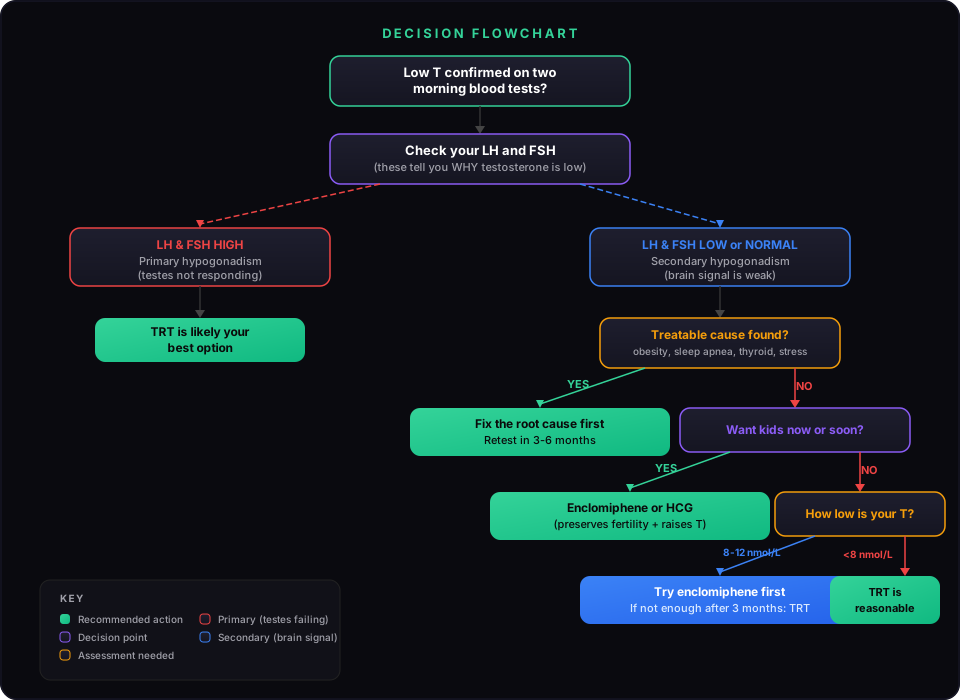
This decision tree covers the most common scenarios. It's a starting point for conversation with your doctor, not a substitute for one.
 Click to expand
The flowchart boils down to three questions:
- Are your testes the problem, or is it the brain signal? (LH/FSH tells you this)
- Is there a fixable root cause? (weight, sleep, thyroid, medications)
- Do you want children now or in the near future?
If your testes are failing (primary hypogonadism with high LH), TRT is likely your best and only real option. If the brain signal is weak (secondary hypogonadism), you have a full menu of alternatives that preserve your body's own production.
What to monitor on each path
Whichever route you choose, regular blood work is non-negotiable. Here's what to test and how often:
| Marker | Lifestyle | Supplements | Enclomiphene | HCG | TRT |
|---|---|---|---|---|---|
| Total T | Every 3-6 months | Every 3-6 months | Every 6-8 weeks initially | Every 6-8 weeks initially | Every 3-6 months |
| Free T | Every 3-6 months | Every 3-6 months | Every 6-8 weeks initially | Every 6-8 weeks initially | Every 3-6 months |
| LH / FSH | Baseline only | Baseline only | Every 6-8 weeks | Every 6-8 weeks | Suppressed (no need) |
| Estradiol | Baseline only | Baseline only | Every 3 months | Every 3 months | Every 3-6 months |
| Haematocrit | Annually | Annually | Every 6 months | Every 6 months | Every 3-6 months |
| SHBG | Every 6 months | Every 6 months | Every 3 months | Every 3 months | Every 6 months |
| Prolactin | Baseline | Baseline | Baseline | Baseline | Baseline |
The best time to draw blood on any protocol is first thing in the morning, fasted, at trough (just before your next dose if you're on medication). Read our blood test timing guide for exact windows by medication type.
Track your results on any path
VitalMetrics lets you log blood work, track trends over time, and get AI-powered analysis with context for whatever protocol you're on. Free to start.
Try it FreeKey takeaways
- A single low testosterone reading is not a diagnosis. Get two morning fasted tests before making any decisions.
- Check LH and FSH. They tell you whether the problem is at the testes (primary) or the brain signal (secondary), which determines your options.
- Rule out fixable causes first: obesity, sleep, thyroid, prolactin, stress, and medications can all suppress testosterone reversibly.
- Enclomiphene is the strongest non-TRT option for secondary hypogonadism. It restores natural production, preserves fertility, and has solid long-term safety data.
- HCG works by stimulating the testes directly but doesn't fix the upstream signal. Access has become harder since 2020.
- Supplements only work reliably for correcting deficiencies (vitamin D, zinc). Ashwagandha is the exception with modest evidence in non-deficient men.
- TRT is effective and well-studied, but it's a lifelong commitment that suppresses fertility and requires ongoing blood monitoring.
- Whichever path you choose, track your blood work. Numbers tell you if your approach is working.

Found this helpful? Keep the articles (and my TRT) going.
References
- McBride, J. A., Carson, C. C., & Coward, R. M. (2016). Testosterone deficiency in the aging male. Therapeutic Advances in Urology, 8(1), 47-60. PubMed
- Kelly, D. M., & Jones, T. H. (2015). Testosterone and obesity. Obesity Reviews, 16(7), 581-606. PubMed
- Leproult, R., & Van Cauter, E. (2011). Effect of 1 week of sleep restriction on testosterone levels in young healthy men. JAMA, 305(21), 2173-2174. PubMed
- Saad, F., Aversa, A., Isidori, A. M., et al. (2011). Onset of effects of testosterone treatment and time span until maximum effects are achieved. European Journal of Endocrinology, 165(5), 675-685. PubMed
- Lincoff, A. M., Bhasin, S., Flevaris, P., et al. (2023). Cardiovascular safety of testosterone-replacement therapy. New England Journal of Medicine, 389(2), 107-117. PubMed
- Christin-Maitre, S., & Young, J. (2022). Androgens and spermatogenesis. Annales d'Endocrinologie, 83(3), 155-158. PubMed
- Rotker, K., Butler, C., Calixte, R., et al. (2018). Increased rate of polycythemia in patients receiving testosterone therapy. Asian Journal of Andrology, 20(6), 550-553. PubMed
- Ory, J., Flannigan, R., Lundeen, C., et al. (2022). Secondary polycythemia in men receiving testosterone therapy increases risk of major adverse cardiovascular events and venous thromboembolism. Journal of Urology, 208(1). PubMed
- Corona, G., Rastrelli, G., Monami, M., et al. (2013). Body weight loss reverts obesity-associated hypogonadotropic hypogonadism. European Journal of Endocrinology, 168(6), 829-843. PubMed
- Moradi, F. (2015). Changes of serum sex hormones after 12-week resistance exercise in obese young men. Asian Journal of Sports Medicine, 6(3), e25411. PubMed
- Balasubramanian, A., Thirumavalavan, N., Srivatsav, A., et al. (2019). Testosterone imposters: an analysis of popular online testosterone boosting supplements. Journal of Sexual Medicine, 16(2), 203-212. PubMed
- Pilz, S., Frisch, S., Koertke, H., et al. (2011). Effect of vitamin D supplementation on testosterone levels in men. Hormone and Metabolic Research, 43(3), 223-225. PubMed
- Lerchbaum, E., Pilz, S., Trummer, C., et al. (2017). Vitamin D and testosterone in healthy men. Journal of Clinical Endocrinology and Metabolism, 102(11), 4292-4302. PubMed
- Prasad, A. S., Mantzoros, C. S., Beck, F. W., et al. (1996). Zinc status and serum testosterone levels of healthy adults. Nutrition, 12(5), 344-348. PubMed
- Wankhede, S., Langade, D., Joshi, K., et al. (2015). Examining the effect of Withania somnifera supplementation on muscle strength and recovery. Journal of the International Society of Sports Nutrition, 12, 43. PubMed
- Lopresti, A. L., Drummond, P. D., & Smith, S. J. (2019). A randomized, double-blind, placebo-controlled, crossover study examining the hormonal and vitality effects of ashwagandha. American Journal of Men's Health, 13(2). PubMed
- Moskovic, D. J., Katz, D. J., Akhavan, A., et al. (2012). Clomiphene citrate is safe and effective for long-term management of hypogonadism. BJU International, 110(10), 1524-1528. PubMed
- Huijben, M., Lock, M. T., de Kemp, V. F., et al. (2022). Clomiphene citrate for men with hypogonadism: a systematic review and meta-analysis. Andrology, 10(3), 451-469. PubMed
- Saffati, G., Hardy, K., Chen, R., et al. (2024). Enclomiphene versus clomiphene in hypogonadal men. Translational Andrology and Urology, 13(9), 2002-2010. PubMed
- Krzastek, S. C., Sharma, D., Abdullah, N., et al. (2019). Long-term safety and efficacy of clomiphene citrate for the treatment of hypogonadism. Journal of Urology, 202(5), 1029-1035. PubMed
- Bouloux, P. M., Nieschlag, E., Burger, H. G., et al. (2003). Induction of spermatogenesis by recombinant follicle-stimulating hormone in hypogonadotropic hypogonadism. Journal of Andrology, 24(4), 604-611. PubMed
- Nass, R., Pezzoli, S. S., Oliveri, M. C., et al. (2008). Effects of an oral ghrelin mimetic on body composition and clinical outcomes in healthy older adults. Annals of Internal Medicine, 149(9), 601-611. PubMed
- Pokrywka, A., Obmiński, Z., Malczewska-Lenczowska, J., et al. (2014). Insights into supplements with Tribulus terrestris used by athletes. Journal of Human Kinetics, 41, 99-105. PubMed
- Rao, A., Steels, E., Beccaria, G., et al. (2016). Influence of a specialized Trigonella foenum-graecum seed extract on testosterone, vitality and sexual function in healthy aging males. Aging Male, 19(2), 134-142. PubMed
Stay on top of your bloodwork
Get evidence-based articles on bloodwork, TRT, and harm reduction delivered to your inbox every two weeks.